


Gloria Nelson has lived in or near Turner Station nearly all her life. Now in her 70s, she leads the Conservation Team in the historically Black community, built around what was once the Bethlehem Steel plant.
“I’m missing my basketball games for the record, but I’m doing this because it’s a good cause,” Nelson said with a laugh as she took WYPR on a neighborhood tour.
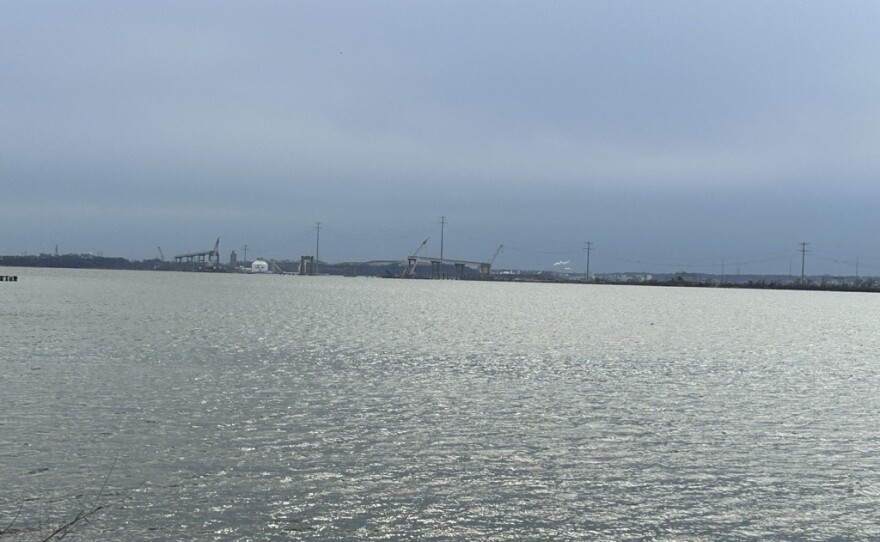
Six people were killed two years ago when the Francis Scott Key Bridge collapsed after the cargo ship Dali lost power and struck the structure. Investigators said a loose wire caused the outage that led to the crash.
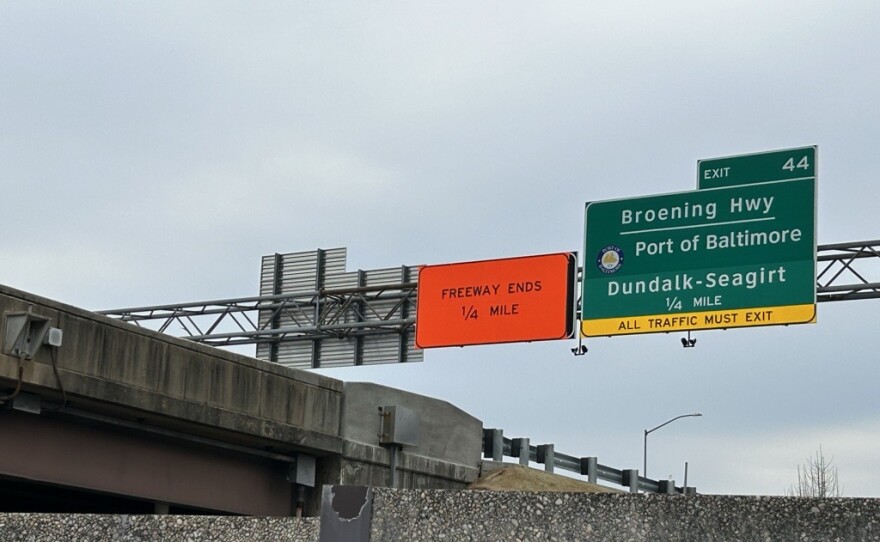
Residents say heavy truck traffic continues to shape daily life, since the collapse. Some drivers still take local roads as shortcuts, despite official efforts to reroute truck traffic.
On Merritt Boulevard, tractor-trailers hauled goods in and out of Tradepoint Atlantic, crowding the roadway. Nelson pointed to a roundabout she and other volunteers once maintained. They’ve since stopped, she said, because heavy trucks frequently damage the easements and even knock down traffic lights.
“It’s really very congested,” she said. “All of these are potholes. But they do fix them as soon as they happen,” she added, crediting the county government.
Nelson plans her day around traffic patterns, waiting until later in the evening to run errands.
But one concern is harder to mitigate: air quality.
“You’re talking about diesel engine exhaustion, and when trucks are idling, you don’t realize when the wind blows it’s blowing it into various communities,” Nelson said. “So health has been a big concern for us. It still is.”
In response, the Turner Station Conservation Team is working with researchers from the University of Maryland and the Johns Hopkins Bloomberg School of Public Health, using funding from the American Rescue Plan, to study local air quality. Air monitors can be seen in the community.
A Johns Hopkins spokesperson said the university maintains sensors. Jay Apperson, a spokesperson for the Maryland Department of the Environment, said two sensor sites are currently operating along Broening Highway in Turner Station, though results have not yet been published.

While traffic and air quality remain the most visible concerns, some residents also worry about potential damage to home foundations tied to ongoing construction and heavy truck activity.
According to the Maryland Transportation Authority (MDTA), teams have inspected and documented the conditions of 1,121 homes near the bridge. The agency has also hosted programs including job fairs, book drives and a Rebuild internship that hired 10 local students.
“We're also reaching people through multiple communication channels, including more than 4,300 email subscribers and 30,000 Facebook followers, along with our Bridging the Facts Facebook series, Keybridge brief e-blasts, and Keynected newsletter,” Melissa Williams, of the Maryland Transportation Authority’s Planning and Community Development team, said.
While the Port of Baltimore has rebounded, generating more than $65 billion in 2025, some local business owners say they are still struggling.
Lauren Quintana, who owns Little Crystal Bijou, said she has seen a sharp drop in customers since the bridge collapse. “By the end of the year, when I was looking at how much business I had lost, it was to the tune of about 40%,” Quintana said.
She has tried to make up the difference through her website, a move not every business can rely on.
“If they’re not used to shopping with me online, it’s just out of sight, out of mind,” she said. “I became an inconvenient place to shop.”
State officials say they are working to address both immediate and long-term impacts as plans for a new bridge move forward.
The replacement span will include protective barriers the size of a football field and a wider main channel to give ships more room to pass.
Jim Harkness, MDTA’s chief engineer, said key details are still being finalized.
“We’re using 70% design to estimate and arrive at an agreed-upon cost and schedule with our contractor, and we expect that over the next couple months,” Harkness said.
Officials expect the final design to be completed in June.


